Wednesday, June 8, 2011

Seven reasons why MU played like FU.....!


The Champions League final is already ancient history. But the tragedy, comedy and mystery linger. Why did Manchester United (MU) play like Felda United (FU)?

MU lost to Barcelona. Well, this should go down as the understatement of the year even with more than six months of the 2011 remaining. The 3-1 scoreline in the one-sided affair on 28 May is technical to the core. It's a 5-0 Catalan cakewalk by any standard of fair play. MU had been ruthless and unstoppable before that Wembley whitewash, dismantling Chelsea and Schalke with aplomb. But the way they’re bullied and battered by Barcelona belies belief.

British tabloids were measured and restrained in their response, taking great pains to cover up darling team's pedestrian performance by heaping praise and more praise on Barcelona. A clever misdirection for an untrained eye. But the rest of us know better. British football literates, pundits and pundeks are, by and large, articulate bootlickers pandering to Sir Alex and his attack dog Gary Neville. Since I don’t owe Alex anything, I’m free to explain and expound why MU played like FU and sank in shame. Don’t get me wrong. I was rooting for MU and wanted them to win simply because of my visceral soft spot for English teams. I was firmly behind Liverpool when they won over and lost to AC Milan. I’ve been following the English League for longer than 100 years now. In my schooldays I begged and borrowed to buy Shoot, a football (not rifle) magazine. It’s only fair that I should be allowed my two-sen.

Now for my seven reasons:

1. Team formation: Fergie’s famed 4-4-2 or 4-4-1-1 or whatever was doomed from the first whistle. Barcelona are unplayable when they’re in form, and they hit form every playing day. So the only formation that has a ghost of a chance is 10-0-0, known lovingly as the PTB. Yes, park the bus. MU should take a leaf out of neighbour’s playbook. Man City’s Mancini, bred and broken in Milan, has honed this fine art to perfection. Italy won the World Cup four times by defending to death.

2. Team line-up: One look at the team, you’ll see a horde of hard runners with a combined skill equivalent to all 30% of Lionel Messi’s. Michael Carrick is a huge talent as a bricklayer, but not a ball-player. Park Ji Sung ran before, during and after the game. He’s still running while you’re reading this.

3. Ryan Giggs: Let’s be honest. This serial shagger had no business groping about on the field alongside Wayne Rooney, a relatively respectable guy given that he’s only an occasional shagger. He should be off the field doing what he does best with that priceless grand injunction.

4. Rio and Vidic: Over-rated and over the hill, this defensive duo were apparently having a divine time watching and marveling at poetry in motion as Barcelona players stroked the ball right under their noses with sheer finesse and panache. Should we blame them?

5. Lionel Messi.

6. British Media and Arsene Wenger: Together they spun the hype. Arse lived up to his name by loudly suggesting a MU win. The media, while grudgingly giving Barelona the nominal edge, were actually bullish and upbeat about MU’s prospects. Result: MU’s pumped-up ego and irrational exuberance. They’re caught pants down and only recovered five seconds from the final whistle.

7. Sir Alex was posturing for the FIFA job: Mere conjecture. MU’s loss would allow a rare opportunity for our friend to be gracious and magnanimous in defeat. He didn’t blame the referee or any conspiracy and looked all-round a saner, cleaner candidate than Blatter or Hammam.


I know some MU hardliners will find this less than funny. Loads of bollocks, they'd howl, baying for my blood. Go ahead, guys. Bring out that video. Oh, I'm sure our friendly PM and wife aren't too offended by these sly digs and jibes at their blue-eyed team. At least I mentioned Felda United in the same breath to balance things out. Touching on the local la liga, my home team Kelantan, the Red Warriors, are all poised for the league and FA Cup titles. Catalan and Kelantan rhyme in an uncanny way. No coincidence if you compare the way both teams play! Now that’s funny.


Saturday, May 14, 2011

A Father-in-law And His Alma Mater

I finally joined the ranks of rookie fathers-in-law when my eldest got hitched recently. I’m not sure what to make of this. Should I celebrate? Nothing to shout about for sure because some of my Tiger Lane classmates are already multiple father-in-law. My good friend Azlan became a father-in-law three times last year. No way to beat this feat, it all seemed, until one of us went one better. He himself got married and became a son-in-law. No sooner had the dust settled than another one followed on, making it two on the trot. Now that’s dandy. While most of us are blissfully in bed with grandmas, they’re on diaper duty and milk runs.

I guess becoming a father-in-law is no longer, or even never, an important milestone, which is a pity. For some, it’s best forgotten. Ask Prince of Wales. When he became a father-in-law recently he’s largely ignored and insulted. People spoke and wrote and raved about his dead wife and his daughter-in-law's living sister. Nothing about him and even less about his new wife. Amid all the media slagging and libido innuendo, Kirk Douglas had to defend his son's huge spousal age gap (25 years) over daughter-in-law Catherine Zeta Jones by proclaiming that "I'd want to have her for myself". A father-in-law, drunk or not, can be your last line of defence.

Modern-day daughters-in-law are fine-looking and seriously cultured. With fast-paced Facebook, twitter traffic and eponymous websites, they're wired to the teeth. They come with hordes of so-called followers and friends, which reminds you of those deviant religious teachers on the lam. Fathers-in-law, be afraid. There's plenty of pressure piled on us to accommodate and even reciprocate this new language, only we're not sure how. Sorry, maybe you know how, but I still have some way to go.

It's unfortunate that, despite the legal appellation (in-law), there’s no special course or training for a prospective father-in-law, unlike lawyers and police. There's not even a Father-in-law's Day to begin with. What we have is jokes. Loads of father-in-law and mother-in-law jokes. Most are cruel, like who to kill first and so on. I wish there’s a manual or handbook, or at least a FAQ, to guide a father-in-law and allow a smooth transition. You know, the delicate dos and don’ts. I need to know, for instance, whether it’s OK for a father-in-law to belt out aloud old Mohd Rafi or Ahmad Jais numbers while his daughter-in-law is twitting or twittering or whatever. Will he be hauled up for improper conduct, like Sir Alex? My good friend Yuzer (another recent father FIL) forced his daughter-in-law to support Liverpool Football Club and watch all their games on Astro. Is this illegal? I guess there's always that proverbial learning curve for both father and daughter (in-law) to adapt and adjust, and, if necessary, water down all expectations. Sounds like plenty of fun in store. Who needs handbooks.

I’d have concluded this short take here if not for the impulse to thicken the plot a bit with a dose of drama. You know I'm proud of my Tiger Lane connection, and I'd rate my first day there way back in 1966 as one of my finest hours. The eight years that followed was a watershed, a life-shaping experience I wouldn’t trade off for anything. I suppose it’s one of life’s little twists that my boy should marry a girl from Ipoh. On a brilliant January morning, I could feel a whiff of sweet nostalgia sweeping over as I watched my son take his marriage vows at Masjid Jamek Tambun, right behind my old school at Tiger Lane. I should celebrate.

Tuesday, April 5, 2011

Spectacular SPM?

SPM results flew in with a flourish. Another record performance, and not totally unexpected. SPM has now turned into a high-scoring spectator sport just like cricket is of late. More than 9000 students aced the exam with all A, compared to about 8000 last year. 403 racked up a mind-blowing all A+, compared with ‘only’ 214 last year. I’m out of breath. The National Grade Average improved from 5.34 to 5.19. Nobody outside the MOE knows how to compute the NGA, but apparently the lower the number the better, unlike the KLSE Composite Index.

No mistake. There’s a clear and present uptrend in SPM performance. Detractors are having a field day, rejecting the glowing statistics with plenty of insinuating and alarmist tone alluding to dumbing down, grade inflation, soft scoring, exam exploitation, electioneering and even new DG. I’m not an educationist. My passion now is behavioural economics and the English Premier League (football, not snooker), so I’m least qualified to judge, let alone offer a cynical hypothesis on this serious subject. But certainly some of the gripes are unfair and unproductive. We’re certainly not academically adrift, so to speak. We have more doctors and dentists today than at any time in the past. Of course, you’d argue that there’re many more students and medical schools now than at any time in the past. Why do you like to argue?

I took an equivalent exam (called MCE) in 1971 and managed a mixed bag of one A, one F, and C’s and P’s in between. I wasn’t unhappy mainly because nobody scored all A as far as I can remember. This year 31 students at my former school scored all A, and it isn’t even the country’s best performer. We’re number 30-something in the SPM league table. More like Blackpool than Liverpool. It's laudable because there're more than 2500 secondary schools in the country. It's laughable because the school is one of only six or so truly national secondary schools that cream off top students from all states in Malaysia, as opposed to the many and more regional ones like SMS, MRSM, SBP and other strange abbreviations. How is it possible for the lesser-known regional upstarts to rout the star-studded national heavyweights like my dear school? You tell me.

During my time, students with perfect score were few and far between. It’s so rare that if you were one of the few, you’d get featured and feted in the local newspapers. Some straight-A students were anything but straight. No, I don’t mean that. What I mean is, you know, their weird and strange demeanour. Freaks of the fourth kind, if you like. There’re always horror stories behind their academic heroics. I still remember reading about a top student from a school in Kuala Kangsar who’s a recluse. He talked to himself in the toilet, a clear symptom of mild bipolar disorder. (Serious bipolar is when you talk to toilets). High-flyers those days were exceptional and extraordinary to the core. The Bobby Fischer and John Nash crowd. To score all A in the good old days, you’ve to be irregular and off the wall, unlike the current crop whose only eccentricity is probably a mild addiction to Gaga or Glee or both.

Most of my former classmates scoff at the SPM spectacle, dismissing it as statistical misdirection. One look at their MCE results and you can understand why. Now the fun part: would my results be any better if I were to take last year’s SPM instead of 1971 MCE? Possible, but not much. I might not flunk Physics. But nothing would’ve changed. I’d still not be a dentist!

Friday, March 18, 2011

Melbourne Memory


You can get burnt in Melbourne. Australia is expensive now, and Melbourne is the most expensive city in Australia. About the only affordable commodity in Melbourne is the free tourist tram and trap that circles the city. But you need to sleep and eat, and this is when an unsuspecting traveller with lousy currency is caught with his pants down (even literally if he's not careful). A half-liter store-branded mineral water costs RM 6.00. Street parking is another RM6, for 30 minutes. Newspapers? RM4.50. But Melbourne is not without its upsides. Grapes are fresh, firm and pleasantly affordable. Pancakes at the Pancake Parlour are made in heaven (price aside). The city is safe, clean and cultured. The people witty and clever. Parks and gardens. No Ah Long phone numbers anywhere. You see more traffic in USJ Taipan than downtown Melbourne at any time. The Economist ranks Melbourne the second most livable city in the world. We can go on.

We're in Melbourne for six days, in 10 March, out 16 March 2011. Why Melbourne? Because it's not Bandung. No. Actually we fall for Air Asia fare fraud, RM 640 including all the shady charges for meals, luggage, oxygen etc. It's a lottery: you book and pay full ten months ahead and then quietly pray to God you'll live long enough to fly. If you lose, they win. If you win, they win. It's win-win, for them. No wonder Tony is so rich.

To be honest I'm not all that fired up for this trip, I mean compared to the UK fling last year. After all, we've been to Gold Coast, Sydney and even sleepy Canberra. Australia is, well, Australia. But things always have a way of developing (whatever it means). Midway into the return flight, without nuts or chips to chomp, the idle mind succumbs to flashbacks. Memories flutter in. Melbourne, decidedly, has its moments.


1. Melbourne Airport (10 March, morning)

Friendlier than Sydney and Brisbane Airports. No dogs sniffing your bags or snapping at your legs. The customs lady even tries, in genuine jest, to pronounce our 'rendang tok'.


2. Hotel Formule 1 (10-12 March, 2 nights)

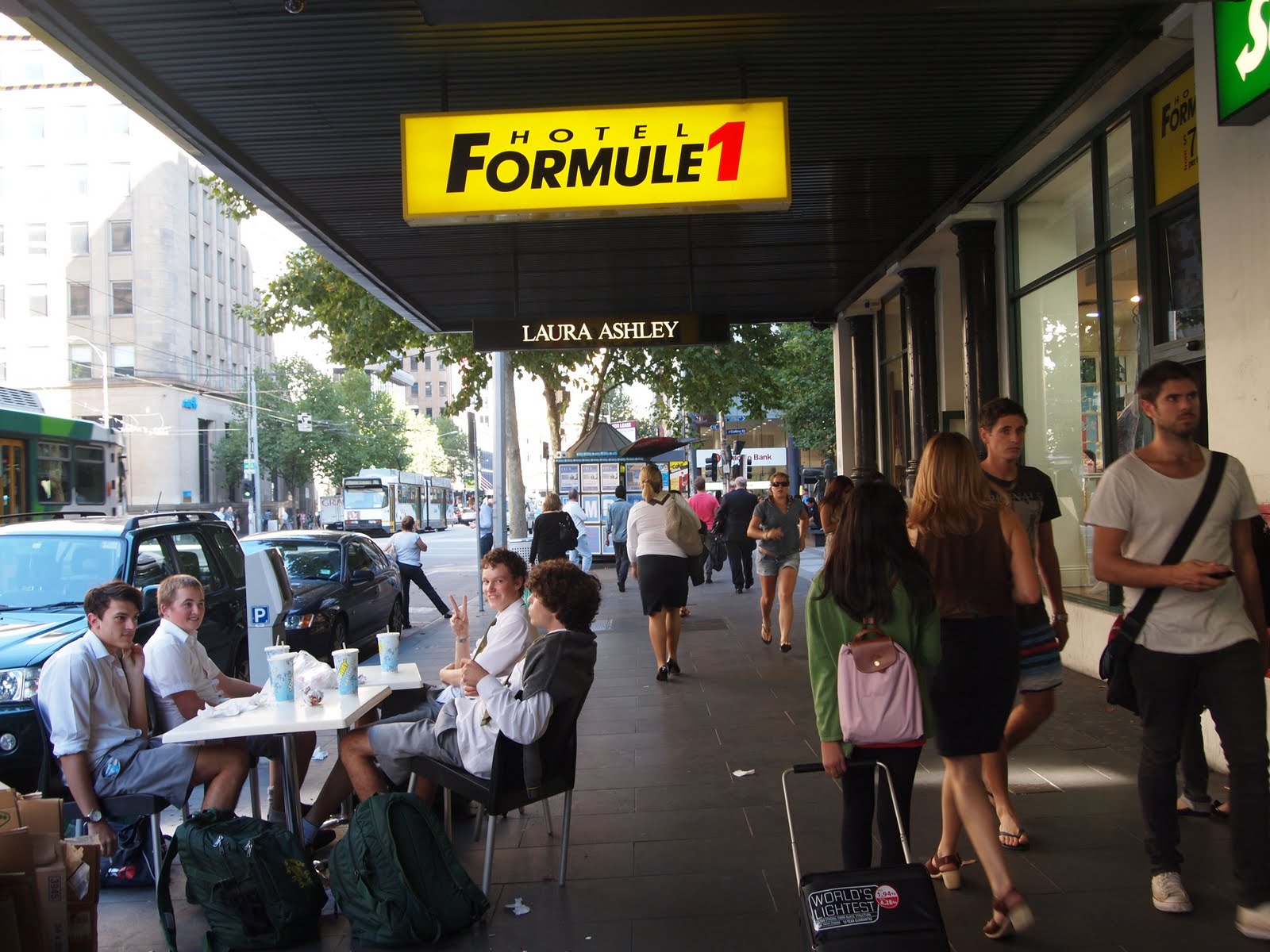
It's French chain minus the chic. Unabashedly spartan, it's anything but F1. Room is slightly bigger than our wet kitchen. Good enough for the five of us, really how little space we actually need to live. And a flatscreen to boot! The hotel is on Elizabeth Street, just 100m from Bourke Street mall, the hippest and coolest part of Melbourne. RM 300 per night, you'd struggle to find a better value in Melbourne.


3. Trams, trams, trams

Nothing more iconic in Melbourne than its trams. Trams on your left, your right, ahead, behind, trams everywhere. I can promise you'll get tired of trams after just two days. They're not cheap, and tickets are confusing with zones, time, days and even your age. Only experienced actuaries can figure out the best deal. We get around the problem by taking the free tourist tram that circles the city. I bet some of the Chinese on that tram were free-loading locals.


4. Great Ocean Road (12-13 march)

Spectacular 200km coastal stretch south-west of Melbourne, with winding and hill-hugging roads. The lavish and lush ocean opens with abandon, but we're here for the Twelve Apostles, rugged limestone columns left behind by retreating headlands. World famous, nationally celebrated, vastly overrated, instantly forgettable. But fish-and-chips at balmy Apollo Bay blows us away, its sweet and crisp whiff still lingers. Port Campbell, where we pitch for the night, is a hiding gem. We come with no baggage of expectation, so what we see is delightfully understated. This pretty-like-postcard fishing village has its own cove and beach to frolic on. Park View Motel is excellent, and even extravagant by our frugal travel standards. Wish you're here.


5. Return to Melbourne via Ballarat (13 March)

We take the inland route on the way back to Melbourne for the opportunity to feast on Victoria's vistas. We cut across rolling and sweeping farms, villages, towns and other rural stuff. Drab and dreary for Aida and Sarah, nothing like Katy Perry. Admittedly not as idyllic as the Lake District, but expressive enough for a retiree without workload. Roads are narrow but so quiet. Speed limit is a generous 100 km/hr, proof that life is much easier without Malaysian bus drivers. Before hitting the freeway, we stop over in Ballarat. Despite the showy name, there's nothing much on show in this old mining town.


6. Penang Inn, Motel Maroondah, Petaling Street (13-16 March)

No. It's still Melbourne, but 15 km out in a neighbourhood named Box Hill. How're we so sure that this is still part of Melbourne? We see lots of trams, that's how. And lots of Chinese and Chinese shops, too. There's a Penang Inn, and a Petaling Street Restaurant that lives up to its name: it opens until 3 am. We put up at Motel Maroondah, a no-frills motel with an unmistakable run-of-the mill charm (ok, ok, it's rundown). But its location offers easy access to regional attractions like Yarra Valley, Dandenong Ranges, Phillip Island, Healesville Animal Sanctuary, Mornington Peninsular and other exotic monikers. But we change our plans, and go somewhere else. We go to, hold your breath, Melbourne Zoo !


7. St Kilda (14 March)

Melbourne's stylish seaside suburb to the south, St Kilda is diverse and colourful, with heavy tourist crowd. There's even an amusement park with roller-coaster and ferris wheel to scam the underage travellers. St Kilda's youngish and offbeat look and feel is unmistakable as we stroll along its noisy Acland Street, the main tourist thoroughfare (If you're above 50, don't come here). The heady stretch is bursting with shops and cafes with fancy names and offerings. We stumble upon a Kotaraya Restaurant and a Chinta Ria Restaurant, and immediately decide that we've seen enough and turn back.


8. Melbourne Zoo (15 March)

Zoos and museums have never featured in our travels. But we make an exception this time because Sarah wants to cuddle koalas. Koalas are native to Australia, much like Mat Rempits are native to Malaysia. Koalas are cute and lovable (unlike Mat Rempits) and active only at night (like Mat Rempits). There are koalas in Melbourne Zoo, snoozing and snoring on a tree, at 12 noon, well out of anybody's reach. As we're not zoo zealots, we can't really rate and compare Melbourne Zoo. But as an intellectual experience it should be better than Taiping Zoo (Perak, not China). We've not been to Taiping Zoo, but we've met a lot of people from Taiping, so we know.

9. Queen Victoria Market (11 and 15 March)

A market with a thousand stalls selling everything imaginable and unimaginable. A notch below expectation actually. Sterile and listless compared with the fast and furious Paddy's Market in Sydney. But why's this memorable? Because we come over twice and come away unimpressed each time.


10. Supre (15 March)

Another Android from Samsung? New Kelantanese sugary pastry? Never heard of this until Aida hounds me days and nights in Melbourne. Apparently it's a local chain retailer for girls clothing and silly things. We finally find it at Doncaster Shoppingtown about 2 km from Box Hill. I'm in luck because it's already ten to 5, Australia is about to close and stop functioning. Does she have enough time to buy anything?

11. Free range chicken eggs.

Ten is tiring, so we make it eleven. This is not a rural attraction or a Melbourne Zoo exhibit. When we see this at a grocer's, Aida's mom thinks she's at last found one food item provided for free in pricey Melbourne. A housewife's dream is threatening to come true. It's not free eggs. Never in Melbourne. It's eggs from free-range chickens. (Reminds you of Eats, Shoots & Leaves?). There's a price loud and clear: AUD 5.50 a dozen (RM 17) . You can get five dozens for the same money at Mydin Subang Jaya, only it's not free-range chickens. Who really cares. Fish prices have gone through the roof. The Arabs are agitating for human rights. Freedom and reproductive style of the poultry is the last of our worries.


Afterword

You're less than inspired. It's OK. We never expect you to pack your bags now and head Down Under. Melbourne is no Paris. And, unlike Malacca the hysterical city, Melbourne doesn't pretend to be anything but Melbourne. We struggle to pin down its true character, if any. English? No. Not with those Chinese shops, Chinatown, Chinese mayor, Chinese Chinese. Cosmopolitan? Not yet. Not until Kelantanese is spoken (loudly) on trams. Melbourne is a shade restrained or measured. Walking and wandering around the city, mingling with the easy crowd, traipsing round the shops, counting trams, is richly rewarding (even more rewarding once you stop comparing and converting prices!). Roaming its wild coastline and quaint countryside adds a fine sense of relish and adventure. Melbourne is good value. At our price, it's a snip (you hate this cliche). Aida and Sarah have a terrific time. Better than math tuition, many times. Read it all in their latest Facebook. We'll always treasure this trip. Only one small regret: we forget to compliment the girl who serves us at the Pancake Parlour on Bourke Street. Warmth and welcome even for skimping customers foraging for free wi fi. We'll look no further for a reason why Melbourne is so lusciously livable.


The Social Network

The social network started not in Silicon Valley, but in Kinta Valley, circa 1970. It's actually founded at the old Tiger Lane in Ipoh. In the students toilet on the ground floor of the main building of Sekolah Tuanku Abdul Rahman (Star), to be exact. The early form was primitive and hand-operated, not digital and real-time, and certainly not as elegant as, say, Facebook or Staroba.Org. But it’s a social network nonetheless, at least in idea, concept and purpose. I'll never know who actually started it, but it's not too late to initiate another lawsuit against Zuckerberg.

Like all great discoveries and inventions, it started rather fortuitously, a serendipitous outcome of widespread anger, rebellious spite and mindless creativity. I’m not sure why and how, but a reign of terror suddenly descended on the good school. Was it the new Headmaster? Or the new head-boy? Or the groovy teacher from Texas with lush sideburns? Nobody knew. Prefects were running riot, enforcing all petty and pretty rules and regulations with an unprecedented fervour and ferocity. Students were rounded up and sent to DC and hard labour for the merest of misdemeanours, like late for debates or switching off lights at 10.35 or knowingly growing sideburns.

My heart bled for the offenders because inter-house English debates those days were only slightly more exciting than watching the matron. (Some debaters even spoke in heavy Kelantanese). For two long hours, you’d to listen to underage boys arguing heatedly on the stage about mundane matters like why “Intermarriage should be encouraged”. I mean, who cared? Why didn’t they round up and detain these deadhead debaters instead? But law is law. Love it or loathe it, you’d to sit through debates. You break the law, we break your leg, the head-boy gently reminded us. Man, how he walked the talk.

Naturally the hawkish stance didn’t go down very well with almost everyone outside the prefects room, not least the kind matron, whose sick bay was suddenly swamped with nervous wrecks. The fun-loving and trendy types were distraught now that their high life was in the cross-hairs. To be fair, they had a pretty strong case. Even without prefect brutality and excesses, life in general was already miserable with compulsory cross-country, Jack Palance movies, and those monster meals dished out by the cooks and crooks in the dining hall. Everyone was crying for breathing space. A bit of fun and merry-making should go a long way.

The prefects were roundly scorned, and sneered at the slightest opportunity. I felt for some of them who must confront their conscience and the dreaded dilemma: turn in the offenders or turn the other way. It pained and tore them because, deep down, they knew that these petty criminals were nothing more than misguided show-offs and small-time crooks not worthy of anybody’s salt. A slap on the wrist should suffice. But for every heart of gold, there’s a heart of coal lurking in the dark corridors. For the latter variety, they stuck and triumphed with the break-your-leg business model.

One of the leg-breakers was a good friend (I’m still proud of this association). No, I won’t name him here, just to get you guessing. So let’s call him my Friend. My Friend was the embodiment of a perfect prefect, easily the best in the entire Kinta Valley. Serious, smart and straight, the only sport he played was, be afraid, chess. Chess! You may argue that chess, like debates, is not a sport. Let’s not discuss this here.

Every now and then, pitched battles broke out between the two warring sides: law breakers versus leg breakers. For passive and fine-looking bystanders like me, the sight of the toned-up and browbeating law breakers could be unnerving. They’re football prodigies and rugby nutcases by day who turned serial smokers and bouncers when night fell. But the prefects were no sissies either. Most were star athletes on steroids: hurdlers, javelin launchers, triple jumpers and, don’t forget, one aspiring chess grandmaster. Fire, decidedly, must be fought with fire.

Spoils of the showdowns sometimes spilled over into the morning assemblies, where the vanquished were paraded. The most serious of offences might even earn the odd offenders the mother of all punishments: public caning (not to be mixed up with public canning, which is even worse). For legal clarity, public caning is caning in public, not caning the public, where public refers to the entire student population of the school, not the entire population of Kinta Valley. The luckless offenders would be caned by the HM or a (reluctant) teacher. I’m still questioning the reformative efficacy of this draconian form of punishment because I could clearly see the cynical and smug smile on their faces as the cane landed on the sweet posteriors. For these unrepentant hard cores, it’s all in a day’s work.

All the underground straw polls run by the students consistently concluded that my Friend was by far the most popular (read disliked, detested, derided), ahead of the hardheaded head-boy. His single-minded and unapologetic approach to law and order had won him legions of followers (read enemies, enemies, enemies). As a straight-thinking and law-loving citizen, I felt this was grossly unfair. Without honest and principled prefects like my Friend, the great school would’ve crumbled and sunk into disorder and decay, eventually losing out to its wholesome and well-behaved neighbour, Sekolah Izzuddin Shah, Ipoh (SISI). Sissy!

No armies in the world can stop an idea whose time has come. Who said this? Hugo Boss? Never mind. One fine day, a flash of brilliance struck one of these so-called followers, who felt something must be done urgently to stop the prefects on their tracks. He started a blog entry on the wall of the toilet, right above the urinals, on the ground floor of the school’s main building. The subject of his blog was, no surprise, my Friend. What he wrote was only slightly milder than pornography, but he seemed to strike the chord. Other followers pitched in, and more followers, and more. The proverbial floodgates crashed in record time. A my Friend thread emerged, and that part of the wall was finally transformed into a flourishing fan site, complete with unflattering comments and caricatures, giving birth to an early form of social network for my Friend’s ardent followers to air and share their rants and rage. As you peed, you pored over the angry entries and clever comments. Toilet trips had never been this good.

Emboldened by the roaring success, more forums and sites emerged, levelling at other heavy-handed honchos in the prefects room. New posts appeared almost every day at any time. No actual names were used, but just like the latter-day social network, it’s a fertile space for the creative mind and the grudging heart. You’d wonder at the variety and choice of words, some were candid and casual, some loud and lewd, all gloriously entertaining. I can assure you that even if you’re a boneless bodger the bookworm without one vein of humour, you’d come out of the toilet smiling, inspired, and ready for English debates. The head-boy and his posse of prefects, for all their strident and gung-ho ways, were now helpless. They knew they’d been hit back, and hard.

So that’s how the social network started. In Kinta Valley, not Silicon Valley.

Note: This retrospective work was inspired, in part, by "The Social Network". Heavily favoured for Best Picture at the recent Academy Awards, it lost to "The King's Speech". The film, however, won an Oscar for Best Film Editing . Just don't ask me what exactly is film editing.

Tuesday, February 8, 2011

Mindless Miscellany ( No. 7)

Year 2011 promises to be one roaring, rabbit year. The super superstitious Chinese seem to believe that every new year brings a lot of luck, regardless of the animal. No year is a bad year. Even a snake year is a good year. I think this is the reason why Restoran Sri Melor, my wife's favourite roti canai joint, is flying a Happy Chinese Year banner with a crude sketch of a tiger on it. It's last year's banner, of course, but what's the difference, since every year is a prosperous year. A rabbit is as a good as a tiger. Mamak is right.

My earliest leporine experience harks back to the early nineties when my two boys were in primary school. We took in a rabbit (or was it a guinea pig?) as our pet. We fed him with carrot. Problem was, this guy ate non-stop, 24/7. I discovered that what he ate in a day was more than my two boys' combined vegetable intake for the whole of 1992. After two weeks, we put him out to pasture (a polite and political way of saying getting rid of a pet). I don't think he ever had a name. He's so busy crunching carrot that we'd no time to even name him.

The mad, mad world continues where it's left off in 2010. A long-running north African strongman fell. Another is fighting for dear life. Crude price is breaching USD100. Torres moved to Chelsea. And it's only February.

1. Pointless Procedure.

By the time you read this, most of the 10,000 or so students studying in various parts of Egypt are safely home, an outcome of a massive evacuation or "rescue operation" involving more than one ministries, more than one airlines, more than one countries (naturally) and, get this, more than one races (read 1 Malaysia). A deputy minister (an Indian) even risked his life. Just about everyone, it seems, pitched in to ensure that the operation was smooth and successful. And why shouldn't it be a success to begin with? What's there to stop us from ferrying those students back home? There's no war, no disaster, no flood and no threat of any form or scale that could potentially be in the way of the operation. The unrest and protests were in Cairo, not anywhere near the student hostels. What's exactly my point? The point is, this whole operation, costing a cool RM30 million, is pointless. Why get the Malaysians out of Egypt? Rescue? From what? Even Hosni Mubarak, the only one who's in real danger, stayed put. The Egyptian people wanted Hosni, not the Malaysian students, out of Egypt. So, if anybody at all should get out of Egypt, it's Hosni, not the Malaysian students. Of course the students, being students, were just too happy to be back in Kedah or Kelantan. They flew AirAsia without having to book one year ahead and buy their inflight meals and luggage space. Fast and free, there's little to complain. Some of them probably had been scraping in the Egyptian desert for six years and had only vague memories of the good life in Malaysia. The irony of all ostensibly well-meaning stunts like this is that they're fiendishly difficult to fault. It has all the look and qualities of a noble and virtuous undertaking. Even if it's politically loaded as alleged by fair-minded detractors, what can be bad about airlifting your people out of a hot spot?

We're remarkable for being consistently inconsistent. Remember when the Indonesian protesters roughed up our Embassy in Jakarta? They defaced, defecated and explicitly warned Malaysians: leave Indonesia or risk forcible ejection. What did we do? We issued a feeble protest note and a mild travel advisory. No rescue operation was even discussed. It's the right decision, of course. But why spend hot money now to "rescue" the Malaysians in Egypt? With ikan tenggiri now running at RM30 a kg and Rotiboy RM2 a pop, the money is better spent on saving Malaysians in Malaysia

2. Park Your Bus, Arse.

My friend, who religiously follows the English Football League, is still scratching his blank pate, full five days after Arsenal squandered a four-goal lead to draw with Newcastle. Had the game gone on for another five minutes, Arsenal would've lost 4-5. Real arse, this Arsenal. I'm not sure, but I heard that it's the first time that something like this happens in EPL. Arsenal are famous for playing a breathless, sophisticated and, at times, highly complex ball-passing football. It's there for all to see in the first half of that game. In the next half, the crybabies simply crumbled and crashed for no apparent reason. Perhaps they forgot to 'park their bus' a bit. It's fashionable now for an EPL team to accuse opponents of 'parking their buses' whenever they fail to win, alluding to opponents' strategy of mass and panic defending with only sporadic attacking (if at all) to protect a draw or a win. Arsenal accused Manchester City of parking their bus in the recent scoreless affair at the Emirates. City, in turn, blamed Blackburn, Birmingham and any team beginning with B for practising this dark art. I'm not sure how this expression got a life, but there's certainly a cynical edge to it. This is unfair. Football is as much about defending as attacking. Italy won the World Cup four times virtually by defending to death each time. It may not be a pretty sight, but there's no rule against parking buses. Arsenal learned this the hard way.

3. Tragic Trend

I've written here about Malaysians being a trendy lot. Bad things are popping up around us in series. Maid abuses, deviant teachings, baby dumping and, of course, bus crashes, slated to be the longest-running sequence in the annals of our country's tolled-road system. Now it's suicide. People are falling and plunging for no reason. Two or three in a day, it's hard to pass it off as isolated or remote. Suicide statistics are dodgy because some of the unexplained deaths have been classified under convenient catch-alls like undetermined, sudden or misadventure. With routine inquests now taking more than a year to return even open verdicts, it's definitely cheaper and greener to determine the cause of a death as misadventure. Something is bothering some of us to death. Ah Longs are the usual suspects, but were quickly ruled out when it's a young Chinese girl. So it's love triangle, or exams, or even tuition. Without early signs, it's difficult to prevent. Of course, there's the incoherent or curious entries in Facebook and so on, but Facebook entries and comments nowadays are mostly muddled and confused to begin with, making it impossible to detect any sign of impending mental dysfunction and breakdown. Suicides are sad and tragic but it's probably a trend. It'll disappear once an overly functioning chief minister comes up with another clever solution.

4. Watch out, wives.

Our Prime Minister's wife reminded all Malaysians to lead a healthy lifestyle, which includes proper dietary habits, plenty of exercise and stress-free homes. According to her, an average of six persons suffer a stroke every hour in Malaysia. She, quite rightly, appealed to all wives not to 'stress' their husbands. She revealed that she herself made it a point not to add stress to her husband's already hectic day. Sorry, I've nothing really to add.


Tuesday, January 18, 2011

In Praise of Poetry / What is This Life

My youngest, Sarah, is now in Form One. She’ll be twelve this year, but she’s still very much my little baby girl. This is tragic because all the cash-crazy airlines and hotels in the world, for some sinister reason, have cruelly colluded to grade any male or female twelve-year old as an adult. Anyway, we went ahead and celebrated her scholastic milestone and commercial coming of age with a low-light, low-cost dinner at a restaurant at Empire Gallery in Subang Jaya, three traffic lights away from our house. She’s all eager and excited: new school, new friends, new prefects. Her school now is just 500 metres away from home. What’s not to like. It’s completely the opposite when her father learned that he’s to go to Tiger Lane (somewhere between the tin mines and the ground-nut farms in Ipoh) for his secondary education. No dinner at fancy restaurant as far as I can remember. No dinner in fact. No restaurant in Kelantan in 1965, to be fair. He’s all apprehensive, uneasy and technically unhappy. New school, check. New friends, check. Prefects, umm, check. Only the school wasn’t 500 m away. It’s 500 km away.

Sarah came back with a bundle of books on the first day. All borrowed books, meaning I didn't have to spend even one sen on text books, a massive financial reprieve for a full-time retiree. You’ve to love this country. I chanced upon one of her English books one evening, and curiously flicked through to compare her standard of English with my Remove Class English. With the raging debates and brickbats on the state of English in the country now, my expectation was no better than that of a Liverpool win. I stopped at page 11 and read. And read again. And again, aloud. There it was, in full glory and grandeur, the perpetual poem ‘Leisure’ by W H Davies:

What is this life if, full of care,
We have no time to stand and stare.

No time to stand beneath the boughs
And stare as long as sheep or cows.

No time to see, when woods we pass,
Where squirrels hide their nuts in grass.

No time to see, in broad daylight,
Streams full of stars like skies at night.

No time to turn at Beauty’s glance,
And watch her feet, how they can dance.

No time to wait till her mouth can
Enrich that smile her eyes began.

A poor life this if, full of care,
We have no time to stand and stare.

I learned this poem in Remove Class way back in 1966. But only now I can appreciate its simplicity and clarity. You get what you see. If only we could all be be as open and outright. The lines rhyme so effortlessly. Now, is Sarah’s English sub-standard or second-rate compared with her father’s Remove Class English? Honestly I’m not sure now. Every time I say ‘poyem’, she shrieks. ‘Pom’, she suggests, with slight e and swagger. She wins.

Anyway, it took me a while to memorize this poem in Kelantanese English or English Kelantanese, you choose. Mr Chan Teng Hong, the class teacher, was just happy and proud that everyone in my class could recite it by heart. I mean everyone except the class monitor. Ask any of my 1966 classmates, and he’ll tell you more.