Friday, March 18, 2011

Melbourne Memory


You can get burnt in Melbourne. Australia is expensive now, and Melbourne is the most expensive city in Australia. About the only affordable commodity in Melbourne is the free tourist tram and trap that circles the city. But you need to sleep and eat, and this is when an unsuspecting traveller with lousy currency is caught with his pants down (even literally if he's not careful). A half-liter store-branded mineral water costs RM 6.00. Street parking is another RM6, for 30 minutes. Newspapers? RM4.50. But Melbourne is not without its upsides. Grapes are fresh, firm and pleasantly affordable. Pancakes at the Pancake Parlour are made in heaven (price aside). The city is safe, clean and cultured. The people witty and clever. Parks and gardens. No Ah Long phone numbers anywhere. You see more traffic in USJ Taipan than downtown Melbourne at any time. The Economist ranks Melbourne the second most livable city in the world. We can go on.

We're in Melbourne for six days, in 10 March, out 16 March 2011. Why Melbourne? Because it's not Bandung. No. Actually we fall for Air Asia fare fraud, RM 640 including all the shady charges for meals, luggage, oxygen etc. It's a lottery: you book and pay full ten months ahead and then quietly pray to God you'll live long enough to fly. If you lose, they win. If you win, they win. It's win-win, for them. No wonder Tony is so rich.

To be honest I'm not all that fired up for this trip, I mean compared to the UK fling last year. After all, we've been to Gold Coast, Sydney and even sleepy Canberra. Australia is, well, Australia. But things always have a way of developing (whatever it means). Midway into the return flight, without nuts or chips to chomp, the idle mind succumbs to flashbacks. Memories flutter in. Melbourne, decidedly, has its moments.


1. Melbourne Airport (10 March, morning)

Friendlier than Sydney and Brisbane Airports. No dogs sniffing your bags or snapping at your legs. The customs lady even tries, in genuine jest, to pronounce our 'rendang tok'.


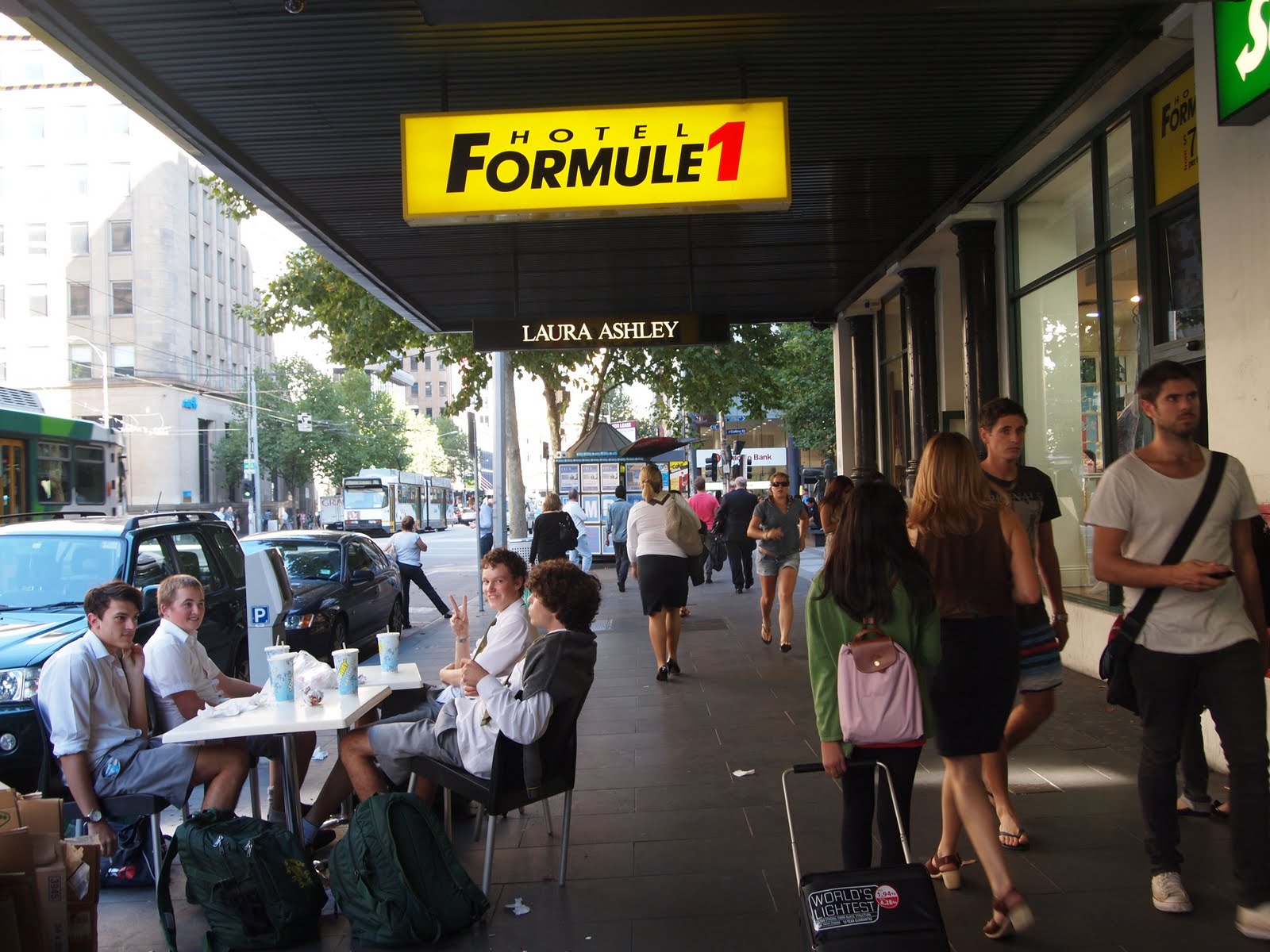
2. Hotel Formule 1 (10-12 March, 2 nights)

It's French chain minus the chic. Unabashedly spartan, it's anything but F1. Room is slightly bigger than our wet kitchen. Good enough for the five of us, really how little space we actually need to live. And a flatscreen to boot! The hotel is on Elizabeth Street, just 100m from Bourke Street mall, the hippest and coolest part of Melbourne. RM 300 per night, you'd struggle to find a better value in Melbourne.

3. Trams, trams, trams

Nothing more iconic in Melbourne than its trams. Trams on your left, your right, ahead, behind, trams everywhere. I can promise you'll get tired of trams after just two days. They're not cheap, and tickets are confusing with zones, time, days and even your age. Only experienced actuaries can figure out the best deal. We get around the problem by taking the free tourist tram that circles the city. I bet some of the Chinese on that tram were free-loading locals.


4. Great Ocean Road (12-13 march)

Spectacular 200km coastal stretch south-west of Melbourne, with winding and hill-hugging roads. The lavish and lush ocean opens with abandon, but we're here for the Twelve Apostles, rugged limestone columns left behind by retreating headlands. World famous, nationally celebrated, vastly overrated, instantly forgettable. But fish-and-chips at balmy Apollo Bay blows us away, its sweet and crisp whiff still lingers. Port Campbell, where we pitch for the night, is a hiding gem. We come with no baggage of expectation, so what we see is delightfully understated. This pretty-like-postcard fishing village has its own cove and beach to frolic on. Park View Motel is excellent, and even extravagant by our frugal travel standards. Wish you're here.


5. Return to Melbourne via Ballarat (13 March)

We take the inland route on the way back to Melbourne for the opportunity to feast on Victoria's vistas. We cut across rolling and sweeping farms, villages, towns and other rural stuff. Drab and dreary for Aida and Sarah, nothing like Katy Perry. Admittedly not as idyllic as the Lake District, but expressive enough for a retiree without workload. Roads are narrow but so quiet. Speed limit is a generous 100 km/hr, proof that life is much easier without Malaysian bus drivers. Before hitting the freeway, we stop over in Ballarat. Despite the showy name, there's nothing much on show in this old mining town.


6. Penang Inn, Motel Maroondah, Petaling Street (13-16 March)

No. It's still Melbourne, but 15 km out in a neighbourhood named Box Hill. How're we so sure that this is still part of Melbourne? We see lots of trams, that's how. And lots of Chinese and Chinese shops, too. There's a Penang Inn, and a Petaling Street Restaurant that lives up to its name: it opens until 3 am. We put up at Motel Maroondah, a no-frills motel with an unmistakable run-of-the mill charm (ok, ok, it's rundown). But its location offers easy access to regional attractions like Yarra Valley, Dandenong Ranges, Phillip Island, Healesville Animal Sanctuary, Mornington Peninsular and other exotic monikers. But we change our plans, and go somewhere else. We go to, hold your breath, Melbourne Zoo !


7. St Kilda (14 March)

Melbourne's stylish seaside suburb to the south, St Kilda is diverse and colourful, with heavy tourist crowd. There's even an amusement park with roller-coaster and ferris wheel to scam the underage travellers. St Kilda's youngish and offbeat look and feel is unmistakable as we stroll along its noisy Acland Street, the main tourist thoroughfare (If you're above 50, don't come here). The heady stretch is bursting with shops and cafes with fancy names and offerings. We stumble upon a Kotaraya Restaurant and a Chinta Ria Restaurant, and immediately decide that we've seen enough and turn back.


8. Melbourne Zoo (15 March)

Zoos and museums have never featured in our travels. But we make an exception this time because Sarah wants to cuddle koalas. Koalas are native to Australia, much like Mat Rempits are native to Malaysia. Koalas are cute and lovable (unlike Mat Rempits) and active only at night (like Mat Rempits). There are koalas in Melbourne Zoo, snoozing and snoring on a tree, at 12 noon, well out of anybody's reach. As we're not zoo zealots, we can't really rate and compare Melbourne Zoo. But as an intellectual experience it should be better than Taiping Zoo (Perak, not China). We've not been to Taiping Zoo, but we've met a lot of people from Taiping, so we know.

9. Queen Victoria Market (11 and 15 March)

A market with a thousand stalls selling everything imaginable and unimaginable. A notch below expectation actually. Sterile and listless compared with the fast and furious Paddy's Market in Sydney. But why's this memorable? Because we come over twice and come away unimpressed each time.


10. Supre (15 March)

Another Android from Samsung? New Kelantanese sugary pastry? Never heard of this until Aida hounds me days and nights in Melbourne. Apparently it's a local chain retailer for girls clothing and silly things. We finally find it at Doncaster Shoppingtown about 2 km from Box Hill. I'm in luck because it's already ten to 5, Australia is about to close and stop functioning. Does she have enough time to buy anything?

11. Free range chicken eggs.

Ten is tiring, so we make it eleven. This is not a rural attraction or a Melbourne Zoo exhibit. When we see this at a grocer's, Aida's mom thinks she's at last found one food item provided for free in pricey Melbourne. A housewife's dream is threatening to come true. It's not free eggs. Never in Melbourne. It's eggs from free-range chickens. (Reminds you of Eats, Shoots & Leaves?). There's a price loud and clear: AUD 5.50 a dozen (RM 17) . You can get five dozens for the same money at Mydin Subang Jaya, only it's not free-range chickens. Who really cares. Fish prices have gone through the roof. The Arabs are agitating for human rights. Freedom and reproductive style of the poultry is the last of our worries.


Afterword

You're less than inspired. It's OK. We never expect you to pack your bags now and head Down Under. Melbourne is no Paris. And, unlike Malacca the hysterical city, Melbourne doesn't pretend to be anything but Melbourne. We struggle to pin down its true character, if any. English? No. Not with those Chinese shops, Chinatown, Chinese mayor, Chinese Chinese. Cosmopolitan? Not yet. Not until Kelantanese is spoken (loudly) on trams. Melbourne is a shade restrained or measured. Walking and wandering around the city, mingling with the easy crowd, traipsing round the shops, counting trams, is richly rewarding (even more rewarding once you stop comparing and converting prices!). Roaming its wild coastline and quaint countryside adds a fine sense of relish and adventure. Melbourne is good value. At our price, it's a snip (you hate this cliche). Aida and Sarah have a terrific time. Better than math tuition, many times. Read it all in their latest Facebook. We'll always treasure this trip. Only one small regret: we forget to compliment the girl who serves us at the Pancake Parlour on Bourke Street. Warmth and welcome even for skimping customers foraging for free wi fi. We'll look no further for a reason why Melbourne is so lusciously livable.


The Social Network

The social network started not in Silicon Valley, but in Kinta Valley, circa 1970. It's actually founded at the old Tiger Lane in Ipoh. In the students toilet on the ground floor of the main building of Sekolah Tuanku Abdul Rahman (Star), to be exact. The early form was primitive and hand-operated, not digital and real-time, and certainly not as elegant as, say, Facebook or Staroba.Org. But it’s a social network nonetheless, at least in idea, concept and purpose. I'll never know who actually started it, but it's not too late to initiate another lawsuit against Zuckerberg.

Like all great discoveries and inventions, it started rather fortuitously, a serendipitous outcome of widespread anger, rebellious spite and mindless creativity. I’m not sure why and how, but a reign of terror suddenly descended on the good school. Was it the new Headmaster? Or the new head-boy? Or the groovy teacher from Texas with lush sideburns? Nobody knew. Prefects were running riot, enforcing all petty and pretty rules and regulations with an unprecedented fervour and ferocity. Students were rounded up and sent to DC and hard labour for the merest of misdemeanours, like late for debates or switching off lights at 10.35 or knowingly growing sideburns.

My heart bled for the offenders because inter-house English debates those days were only slightly more exciting than watching the matron. (Some debaters even spoke in heavy Kelantanese). For two long hours, you’d to listen to underage boys arguing heatedly on the stage about mundane matters like why “Intermarriage should be encouraged”. I mean, who cared? Why didn’t they round up and detain these deadhead debaters instead? But law is law. Love it or loathe it, you’d to sit through debates. You break the law, we break your leg, the head-boy gently reminded us. Man, how he walked the talk.

Naturally the hawkish stance didn’t go down very well with almost everyone outside the prefects room, not least the kind matron, whose sick bay was suddenly swamped with nervous wrecks. The fun-loving and trendy types were distraught now that their high life was in the cross-hairs. To be fair, they had a pretty strong case. Even without prefect brutality and excesses, life in general was already miserable with compulsory cross-country, Jack Palance movies, and those monster meals dished out by the cooks and crooks in the dining hall. Everyone was crying for breathing space. A bit of fun and merry-making should go a long way.

The prefects were roundly scorned, and sneered at the slightest opportunity. I felt for some of them who must confront their conscience and the dreaded dilemma: turn in the offenders or turn the other way. It pained and tore them because, deep down, they knew that these petty criminals were nothing more than misguided show-offs and small-time crooks not worthy of anybody’s salt. A slap on the wrist should suffice. But for every heart of gold, there’s a heart of coal lurking in the dark corridors. For the latter variety, they stuck and triumphed with the break-your-leg business model.

One of the leg-breakers was a good friend (I’m still proud of this association). No, I won’t name him here, just to get you guessing. So let’s call him my Friend. My Friend was the embodiment of a perfect prefect, easily the best in the entire Kinta Valley. Serious, smart and straight, the only sport he played was, be afraid, chess. Chess! You may argue that chess, like debates, is not a sport. Let’s not discuss this here.

Every now and then, pitched battles broke out between the two warring sides: law breakers versus leg breakers. For passive and fine-looking bystanders like me, the sight of the toned-up and browbeating law breakers could be unnerving. They’re football prodigies and rugby nutcases by day who turned serial smokers and bouncers when night fell. But the prefects were no sissies either. Most were star athletes on steroids: hurdlers, javelin launchers, triple jumpers and, don’t forget, one aspiring chess grandmaster. Fire, decidedly, must be fought with fire.

Spoils of the showdowns sometimes spilled over into the morning assemblies, where the vanquished were paraded. The most serious of offences might even earn the odd offenders the mother of all punishments: public caning (not to be mixed up with public canning, which is even worse). For legal clarity, public caning is caning in public, not caning the public, where public refers to the entire student population of the school, not the entire population of Kinta Valley. The luckless offenders would be caned by the HM or a (reluctant) teacher. I’m still questioning the reformative efficacy of this draconian form of punishment because I could clearly see the cynical and smug smile on their faces as the cane landed on the sweet posteriors. For these unrepentant hard cores, it’s all in a day’s work.

All the underground straw polls run by the students consistently concluded that my Friend was by far the most popular (read disliked, detested, derided), ahead of the hardheaded head-boy. His single-minded and unapologetic approach to law and order had won him legions of followers (read enemies, enemies, enemies). As a straight-thinking and law-loving citizen, I felt this was grossly unfair. Without honest and principled prefects like my Friend, the great school would’ve crumbled and sunk into disorder and decay, eventually losing out to its wholesome and well-behaved neighbour, Sekolah Izzuddin Shah, Ipoh (SISI). Sissy!

No armies in the world can stop an idea whose time has come. Who said this? Hugo Boss? Never mind. One fine day, a flash of brilliance struck one of these so-called followers, who felt something must be done urgently to stop the prefects on their tracks. He started a blog entry on the wall of the toilet, right above the urinals, on the ground floor of the school’s main building. The subject of his blog was, no surprise, my Friend. What he wrote was only slightly milder than pornography, but he seemed to strike the chord. Other followers pitched in, and more followers, and more. The proverbial floodgates crashed in record time. A my Friend thread emerged, and that part of the wall was finally transformed into a flourishing fan site, complete with unflattering comments and caricatures, giving birth to an early form of social network for my Friend’s ardent followers to air and share their rants and rage. As you peed, you pored over the angry entries and clever comments. Toilet trips had never been this good.

Emboldened by the roaring success, more forums and sites emerged, levelling at other heavy-handed honchos in the prefects room. New posts appeared almost every day at any time. No actual names were used, but just like the latter-day social network, it’s a fertile space for the creative mind and the grudging heart. You’d wonder at the variety and choice of words, some were candid and casual, some loud and lewd, all gloriously entertaining. I can assure you that even if you’re a boneless bodger the bookworm without one vein of humour, you’d come out of the toilet smiling, inspired, and ready for English debates. The head-boy and his posse of prefects, for all their strident and gung-ho ways, were now helpless. They knew they’d been hit back, and hard.

So that’s how the social network started. In Kinta Valley, not Silicon Valley.

Note: This retrospective work was inspired, in part, by "The Social Network". Heavily favoured for Best Picture at the recent Academy Awards, it lost to "The King's Speech". The film, however, won an Oscar for Best Film Editing . Just don't ask me what exactly is film editing.

Tuesday, February 8, 2011

Mindless Miscellany ( No. 7)

Year 2011 promises to be one roaring, rabbit year. The super superstitious Chinese seem to believe that every new year brings a lot of luck, regardless of the animal. No year is a bad year. Even a snake year is a good year. I think this is the reason why Restoran Sri Melor, my wife's favourite roti canai joint, is flying a Happy Chinese Year banner with a crude sketch of a tiger on it. It's last year's banner, of course, but what's the difference, since every year is a prosperous year. A rabbit is as a good as a tiger. Mamak is right.

My earliest leporine experience harks back to the early nineties when my two boys were in primary school. We took in a rabbit (or was it a guinea pig?) as our pet. We fed him with carrot. Problem was, this guy ate non-stop, 24/7. I discovered that what he ate in a day was more than my two boys' combined vegetable intake for the whole of 1992. After two weeks, we put him out to pasture (a polite and political way of saying getting rid of a pet). I don't think he ever had a name. He's so busy crunching carrot that we'd no time to even name him.

The mad, mad world continues where it's left off in 2010. A long-running north African strongman fell. Another is fighting for dear life. Crude price is breaching USD100. Torres moved to Chelsea. And it's only February.

1. Pointless Procedure.

By the time you read this, most of the 10,000 or so students studying in various parts of Egypt are safely home, an outcome of a massive evacuation or "rescue operation" involving more than one ministries, more than one airlines, more than one countries (naturally) and, get this, more than one races (read 1 Malaysia). A deputy minister (an Indian) even risked his life. Just about everyone, it seems, pitched in to ensure that the operation was smooth and successful. And why shouldn't it be a success to begin with? What's there to stop us from ferrying those students back home? There's no war, no disaster, no flood and no threat of any form or scale that could potentially be in the way of the operation. The unrest and protests were in Cairo, not anywhere near the student hostels. What's exactly my point? The point is, this whole operation, costing a cool RM30 million, is pointless. Why get the Malaysians out of Egypt? Rescue? From what? Even Hosni Mubarak, the only one who's in real danger, stayed put. The Egyptian people wanted Hosni, not the Malaysian students, out of Egypt. So, if anybody at all should get out of Egypt, it's Hosni, not the Malaysian students. Of course the students, being students, were just too happy to be back in Kedah or Kelantan. They flew AirAsia without having to book one year ahead and buy their inflight meals and luggage space. Fast and free, there's little to complain. Some of them probably had been scraping in the Egyptian desert for six years and had only vague memories of the good life in Malaysia. The irony of all ostensibly well-meaning stunts like this is that they're fiendishly difficult to fault. It has all the look and qualities of a noble and virtuous undertaking. Even if it's politically loaded as alleged by fair-minded detractors, what can be bad about airlifting your people out of a hot spot?

We're remarkable for being consistently inconsistent. Remember when the Indonesian protesters roughed up our Embassy in Jakarta? They defaced, defecated and explicitly warned Malaysians: leave Indonesia or risk forcible ejection. What did we do? We issued a feeble protest note and a mild travel advisory. No rescue operation was even discussed. It's the right decision, of course. But why spend hot money now to "rescue" the Malaysians in Egypt? With ikan tenggiri now running at RM30 a kg and Rotiboy RM2 a pop, the money is better spent on saving Malaysians in Malaysia

2. Park Your Bus, Arse.

My friend, who religiously follows the English Football League, is still scratching his blank pate, full five days after Arsenal squandered a four-goal lead to draw with Newcastle. Had the game gone on for another five minutes, Arsenal would've lost 4-5. Real arse, this Arsenal. I'm not sure, but I heard that it's the first time that something like this happens in EPL. Arsenal are famous for playing a breathless, sophisticated and, at times, highly complex ball-passing football. It's there for all to see in the first half of that game. In the next half, the crybabies simply crumbled and crashed for no apparent reason. Perhaps they forgot to 'park their bus' a bit. It's fashionable now for an EPL team to accuse opponents of 'parking their buses' whenever they fail to win, alluding to opponents' strategy of mass and panic defending with only sporadic attacking (if at all) to protect a draw or a win. Arsenal accused Manchester City of parking their bus in the recent scoreless affair at the Emirates. City, in turn, blamed Blackburn, Birmingham and any team beginning with B for practising this dark art. I'm not sure how this expression got a life, but there's certainly a cynical edge to it. This is unfair. Football is as much about defending as attacking. Italy won the World Cup four times virtually by defending to death each time. It may not be a pretty sight, but there's no rule against parking buses. Arsenal learned this the hard way.

3. Tragic Trend

I've written here about Malaysians being a trendy lot. Bad things are popping up around us in series. Maid abuses, deviant teachings, baby dumping and, of course, bus crashes, slated to be the longest-running sequence in the annals of our country's tolled-road system. Now it's suicide. People are falling and plunging for no reason. Two or three in a day, it's hard to pass it off as isolated or remote. Suicide statistics are dodgy because some of the unexplained deaths have been classified under convenient catch-alls like undetermined, sudden or misadventure. With routine inquests now taking more than a year to return even open verdicts, it's definitely cheaper and greener to determine the cause of a death as misadventure. Something is bothering some of us to death. Ah Longs are the usual suspects, but were quickly ruled out when it's a young Chinese girl. So it's love triangle, or exams, or even tuition. Without early signs, it's difficult to prevent. Of course, there's the incoherent or curious entries in Facebook and so on, but Facebook entries and comments nowadays are mostly muddled and confused to begin with, making it impossible to detect any sign of impending mental dysfunction and breakdown. Suicides are sad and tragic but it's probably a trend. It'll disappear once an overly functioning chief minister comes up with another clever solution.

4. Watch out, wives.

Our Prime Minister's wife reminded all Malaysians to lead a healthy lifestyle, which includes proper dietary habits, plenty of exercise and stress-free homes. According to her, an average of six persons suffer a stroke every hour in Malaysia. She, quite rightly, appealed to all wives not to 'stress' their husbands. She revealed that she herself made it a point not to add stress to her husband's already hectic day. Sorry, I've nothing really to add.


Tuesday, January 18, 2011

In Praise of Poetry / What is This Life

My youngest, Sarah, is now in Form One. She’ll be twelve this year, but she’s still very much my little baby girl. This is tragic because all the cash-crazy airlines and hotels in the world, for some sinister reason, have cruelly colluded to grade any male or female twelve-year old as an adult. Anyway, we went ahead and celebrated her scholastic milestone and commercial coming of age with a low-light, low-cost dinner at a restaurant at Empire Gallery in Subang Jaya, three traffic lights away from our house. She’s all eager and excited: new school, new friends, new prefects. Her school now is just 500 metres away from home. What’s not to like. It’s completely the opposite when her father learned that he’s to go to Tiger Lane (somewhere between the tin mines and the ground-nut farms in Ipoh) for his secondary education. No dinner at fancy restaurant as far as I can remember. No dinner in fact. No restaurant in Kelantan in 1965, to be fair. He’s all apprehensive, uneasy and technically unhappy. New school, check. New friends, check. Prefects, umm, check. Only the school wasn’t 500 m away. It’s 500 km away.

Sarah came back with a bundle of books on the first day. All borrowed books, meaning I didn't have to spend even one sen on text books, a massive financial reprieve for a full-time retiree. You’ve to love this country. I chanced upon one of her English books one evening, and curiously flicked through to compare her standard of English with my Remove Class English. With the raging debates and brickbats on the state of English in the country now, my expectation was no better than that of a Liverpool win. I stopped at page 11 and read. And read again. And again, aloud. There it was, in full glory and grandeur, the perpetual poem ‘Leisure’ by W H Davies:

What is this life if, full of care,
We have no time to stand and stare.

No time to stand beneath the boughs
And stare as long as sheep or cows.

No time to see, when woods we pass,
Where squirrels hide their nuts in grass.

No time to see, in broad daylight,
Streams full of stars like skies at night.

No time to turn at Beauty’s glance,
And watch her feet, how they can dance.

No time to wait till her mouth can
Enrich that smile her eyes began.

A poor life this if, full of care,
We have no time to stand and stare.

I learned this poem in Remove Class way back in 1966. But only now I can appreciate its simplicity and clarity. You get what you see. If only we could all be be as open and outright. The lines rhyme so effortlessly. Now, is Sarah’s English sub-standard or second-rate compared with her father’s Remove Class English? Honestly I’m not sure now. Every time I say ‘poyem’, she shrieks. ‘Pom’, she suggests, with slight e and swagger. She wins.

Anyway, it took me a while to memorize this poem in Kelantanese English or English Kelantanese, you choose. Mr Chan Teng Hong, the class teacher, was just happy and proud that everyone in my class could recite it by heart. I mean everyone except the class monitor. Ask any of my 1966 classmates, and he’ll tell you more.

Monday, December 20, 2010

The Lady Ran

It all seems banal and benign enough. I’ve to walk briskly and run at two stretches, back and forth seven times, 420 metres each time, for a total distance of roughly three km. Three km. I’ve been running 10 km every evening back home. This is going to be a cakewalk.

The lady ran. Her baby cried, and cried incessantly. He’s thirsty. Water, where’s water. She must find water for the infant Ismail. The blazing sun and the burning sand conspired as the smell of death overwhelmed any prospect of water. Oh God, is this Your test? Gripped by panic and fear, she ran frantically back and forth, in search of water.

I walked and trotted and walked, hardly ruffled. The first leg was a breeze. But as I pressed on through the throng, my fertile mind began to conjure up visions and questions. Images of the stricken lady appeared in flashes, panic and fear in her eyes! How could I not feel for her. What if it’s my wife and my baby? Or my mother and the infant me? What's supposed to be a routine reenactment of the lady's frantic runs turned into a poignant walk of poetic proportions. My proud 10 km run is absolutely, utterly poor and pointless compared to the lady’s flailing run. God, this is all so humbling. After the third turn, the man and the wall in me simply cracked and caved in. I broke, choked and….

Back from Hajj. Still thinking of the sai'e. Just can't get over it.

Tuesday, October 26, 2010

Tests and Testosterone

I'd always consider myself a bit of an oddity and an outlier among the Tiger Lane brethren on at least one count: my youngest is in primary school, and her sister in lower secondary. Sarah is sitting for UPSR this year and Aida PMR. My classmates, by and large, are way past this fun and festive period. Some are passionately engaged in sports. Not golf, the slow-blow sport, but the high-energy types like football and the hurdles, all at a tender age of 57. But most are now busy marrying off grown-up sons and daughters. One was so busy that he married off three sons at one go! A novel and original solution to a perennial logistical problem. Another one went one better when he married himself off. He'd apparently found a solution to all problems(or was it the mother of all problems?) Oh, a couple of guys in our ranks are still on diaper duty, an outcome of yet another high-octane activity. Don’t beat yourself up just yet because it's not level playing field, if you know what I mean.

Pushing sixty with my over-run, skinhead persona, I'd easily pass for one of those grandfather-rappers in cargo pants waiting for their teenage charges outside the school gate. That's alright with me. I feel young and healthy because of them. It's payback time of sorts, as they'd been left to fend for themselves when I was deep in corporate hellhole. My retirement couldn't have been more opportune, just in time to prepare them for their exams. My ambition now is to transform them into near-geniuses, good enough for Princeton, and, who knows, one of them might even end up marrying a President or Prime Minister! Sorry, bad joke. I know you can take the whole range of jokes. I had plenty during my school days. Food jokes, HM-with-Kedah-accent jokes, Sekolah Izzuddin Shah Ipoh (SISI) jokes. My physics and chemistry grades were best-kept jokes. My good friend Azlan and his posse of prefects were, by default and design, a fertile and steady source of jokes.

Sorry for the digression. Back to the serious subject of my girls and their tests. It’s like a huge proverbial monkey off my back when the exams were finally done and dusted. There's no UPSR or a similar test during my time. But I remember LCE, a PMR equivalent. I’d thought LCE was tougher because it’s in staid English but I quickly changed my mind when I read Aida’s textbooks and was stumped by the plethora of strange and even fancy Malay words and terms like nyah tinja and pasangan tertib. Until this day my parents didn’t know that I’d sat for LCE. It’s definitely a world of difference between my parents and my girls' parents. I know my girls’ exam timetables. I feed up my girls with brain nutrients like double cheeseburgers. But this attack of awareness isn’t necessarily laudable. Why? Because I’ve to also fork out something like RM500 a month for their tuition, that’s why. Outsourcing of tuition is tragic because teaching is a huge missed opportunity for paternal bonding and learning. But I can't do it myself. Malay as a learning language has developed beyond recognition, and I've to unlearn, learn and relearn if I want to teach the girls any subject. To prove this point, let's attempt Question 5 of the recent PMR BM Paper 1, which had me flailing and flagging in despair. (This is an actual question, not a prefect joke):

Question: Zulkifli berasa.....................apabila melihat Zaleha yang disangkanya telah meninggal dunia muncul secara tiba-tiba di hadapannya.

Answer: A. kaget B. takjub C. kagum D. pelik

Be very afraid. This is figurative and literal Bean. Aida checked D and was roundly roasted because, according to her teachers, the right answer was A. kaget. Aida’s mum was furious because kaget wasn’t even Malay. It's Indonesian and probably illegal, just like cewek and cowok. It's hard to argue because she'd been watching all those serials. This Malay mayhem, for some reason, reminds me of my former HM, (Datuk)Mohd Khalid Halim. Long on passion but short on patience, he spoke Malay or English with a thick Kedah accent which got thicker when he lost his temper and turned physical. I always thought his grasp of the Malay language was kind of suspect, which makes me wonder how would he handle this question. And how would he handle (or manhandle) the person who wrote the question, if he ever gets to meet him. For an average and active Kelantanese, I’d rate my Malay as excellent. In my mind all the above answers are, technically, fine. But takut would be the best answer in the context but somehow it’s not there. Sending my girls to tuition is a right decision. Fire must be fought with fire.

Apart from the colourful Malay language, there are other glaring differences between my LCE experience at Tiger Lane (a residential school) and Aida’s PMR experience at a humble daily school close to home. For starters, she doesn’t have to attend evening preps in sarong like I did. She steps out for tuition in whatever fashion she fancies. She eats any time she feels like eating while I had to wait for the sweet ritual ring of the bell three times a day. What does she eat? KFC, McD and all the juicy stuff while I’d to contend with the unbranded and scary stuff prepared by the cooks and spooks in the kitchen. I’ll skip the taste comparison. Finally what comes between Aida and a possible straight-A performance is the three main sources of distraction: Facebook, Astro and Lady Gaga. While my only distraction was the prefects, but there’re thirty of them! The upshot of all this is that Aida’s better prepared and conditioned for the exam compared to her dally daddy. So there’s no reason for her not to outperform him. I’ll update you on this once her PMR results are in.

Exams are an obsession and a big industry now. Parents rudely confront teachers for a slight slip in their children's midterms. Lady teachers retire early to open money-spinning tuition centres. Fathers go back early to send children to these tuition centres. Mothers cook early to feed children before their tuition. Perhaps this exam sub-culture and mindset that's bothering the fair-minded people at the Ministry of Education (MOE). A proposal to scrap UPSR and PMR had been floated for years, and recently it took a serious turn when people from all corners of life (only Nepalese security guards and illegal immigrants were excluded) were solicited for ideas and feedback. Why ditch these exams? Well, according to the hard-thinking MOE people, exams breed rote learning and stifle creativity and thinking skills among students. If you asked me, I'd be more worried if there’s lack of creativity and thinking skills among teachers, what with all the telltale signs like the above PMR question. (Don't worry if you don't know what rote learning is. Neither do I. But it sounds bad, so it must be bad). The education minister finally announced in Sydney on 9 October that UPSR would stay with a new format, while PMR would be replaced by a school-based assessment beginning 2016. My immediate and two-sen response to this was, why Australia?

What exactly is this school-based assessment? I’m not supposed to think because I’m fully retired. So your guess is better than mine. It’s still a long way from now to 2016. In this age of internet chatting and blogging, it’s an eternity. So expect another flip-flop and volte-face. Remember cluster schools? Maths and science in English? Moving SPM grades from A1 to 1A to A+? And back to vocational schools? Scrapping public exams is never a good idea, not for the reasons cited at least. I'm not sure about your girls, but my two girls won't open their books without strong, hard-hitting reasons like UPSR and PMR. School exams, mid-term or end-year, are right behind You Tube in priority and urgency. There's already so much distraction in their lives, why take away the one denominator that's keeping all our children on a straight line?

Sensing the fragility of this issue, the MOE showed off their thinking skills by proclaiming that public exams are costly. Without the exams, the government will save hundreds of millions ringgit (they forgot to mention my good RM500/month). This suggestion smacks of desperation because it doesn’t quite add up. If the government really wants to save, the better option is to do away with schools, teachers, free text books, students and, laugh with me, the MOE. This will encourage thinking skills. Our thinking skills. Because now we’ve to figure out how to educate our girls.

Wednesday, September 1, 2010

Malaysia and Indonesia: A groovy kind of love


They're at it again. Screaming down and roughing up the Malaysian Embassy, threatening to root out every Malaysian in Jakarta, and prepping up for all-out war. It's all too familiar. We've seen this many times before, only the scale of frenzy and fury now is more frightening. There's so much hate and spite on display. Fiery faces and filthy faeces, graphic and shocking even by Indonesian standards. You just wonder what can be worse than this.

For all the crush-Malaysia hysterics, I've always had a soft spot for Indonesia. Some of my good friends are Indonesians. I don't mean my contractor or plumber, although they're good friends too. What I mean is friends in Jakarta, Surabaya and Medan, places that I used to ply my trade during my final years with Petronas. People like Mariezka, Rifki, Faisal, Ahmad Bambang, Darius, Hanung, Muid, Yoko, Djoko, Koko, Desrial, Bayu, Wisnu, Adi Subagio, Hidayat, Ibu Nina, Haris, just to name a few that I can spell with confidence. I can't for a second imagine any of them among the crowd, burning Malaysian flags and shouting 'Ganyang Malaysia!'

Vini, Vedi, Vici

My Indonesia inroads began in early 2004. The Indonesia oil market had just been liberalized to allow entry of foreign players, and I went there specifically to start a petrol retailing business. We're all game and gung-ho, relishing the prospect of building the first Petronas service station in Indonesia. If we can build in Banding, we can build in Bandung. On personal level, it's a rare opportunity of making a difference, to the company and the country (really? Cemerlang, gemilang, terbilang?) Well, nothing like climbing the Everest or the outer space, of course. The task seemed simple enough, until I realized that we're in Indonesia, not Indiana. The whole country was a huge project in progress, nothing was in place except bureaucrats and backhanders. How do you break Pertamina's hundred years of firm monopoly? How do you ride against the torrent of deep nationalism and cultural barriers? Suddenly it's beginning to look like the Everest.

The first day at Petronas office at Bapindo Plaza in Jakarta feels like yesterday. I was together with Husnin and Hilmi from KL on this project, and we're received by a youngish President Director named Faris (not an Indon, but as close as you can get since he's from Batu Pahat), and he introduced us to a young Indonesian lady named Mariezka. Nothing spectacular except for the short and strange name, probably meaningless, too. "Mariezka will help you out with your work in Jakarta". Husnin and I had between us about 50 years of retail business experience, and this girl was going to help us ! Faris must be stoned or something. We sat down for a lengthy but rather casual business discussion and, in the thick of it all, Mariezka's more personal details inevitably trickled out. She's from Bangka island, single and, you've to believe this, she's an engineering graduate. I could sense an air of nonchalance despite her sketchy working experience. We're clearly unimpressed. She could be a model from Mongolia or butcher from Baghdad for all I cared. We're on a serious project here. A national interest was at stake.

The going was rough initially because we're in Indonesia (not Indiana). We're at a loss, moving in fits and starts. We gate-crashed the oil and gas directorate (Migas) every Monday morning and met different people each time. Migas changed the ground rules and goal posts every other week. Datuk Anuar (Oil Business VP and project champion) was on my back all the time and his mind was all made up. He wanted a petrol station in two weeks. And beat Shell to it for good measure. Yet I was extremely cautious, circumspect at every turn, erring on the side of right rather than speed. In hindsight, it's a wise decision not to remind him that we're in Indonesia, not Indiana. He's a rugby player and you wouldn't want him to get physical. As laboured on, it finally dawned on my senses that the engineer from Bangka wasn't just helpful. She's indispensable. Indonesia was crawling with cronies and talented showmen, but she's always one step ahead. I could see that the men fell quite easily for her easy and disarming demeanour and finesse. Just right, not less, not more. She could break and melt even the toughest and wackiest anti-Malaysia nut among the 230 million Indonesians. We finally secured our license, a piece of land and a supply storage to start our business. I could see Mariezka's deft touches all over. And what a reversal, because I've to bite the bullet and admit here that I learned a lot from her. Did she learn anything from me? Yes, a few Kelantanese words.

We operated our first service station, in Cibubur, just outside Jakarta, in December 2005, almost two years after my first trip to Jakarta, and two months after Shell. The station location was a marketing tour de force: President Susilo (SBY) had to pass our bright and beautiful station every time he went back to his home in Cibubur. Nobody knew whether he's inspired or insulted. Probably a bit of both. Even after so many years, I still choked every time I passed that station.

Jakarta jokes

I finally lost count of the trips I made to Jakarta. But I still remember that, into my third month, the Grand Hyatt staff began to address me as Datuk, and despite my (feeble) attempt to discourage them, it stuck until my last trip in 2009. I didn't bother to find out which bellboy started it, but I figured if they're happy to address me that way, why upset them. After all I didn't have to pay a single rupiah extra. So whenever my champion Datuk Anuar visited Jakarta and put up at the hotel, I kept a safe distance, just in case. Rugby player, remember?

The key success factor in Indonesia business is chumming up with as many people as you can, learning their full names, nicknames, phone numbers, karaoke numbers and so on. It's easy to mix up names. Djoko, Yoko, Koko. Matching names with the right persons was an art. I perfected it by loudly chanting the names using the technique developed by the world-famous Gregorian monks. I've met and dealt with easily more than a hundred different Indonesians over the period, and more often than not things didn't go my way. (I could repeat that Indonesia/Indiana routine, but is enough is enough). But I'd be hard pressed to find even one time when I felt offended. They're nice to the bone. Their yes and no were doublespoken in the same pitch, tone and face that by the time I realized they'd rejected my proposal, it's already too late.


There's a lot to learn from each other if we're not too engrossed in self-delusion. For starters, Malaysians are generally serious and surly, talk in one flat tone, and turn to reckless driving and illegal parking to beat the boredom. Indonesians are a more gregarious and happier lot with loads of good humour. Every one of them can sing and joke better than Mawi any day. Their language skills often left me short of breath. We should thank the Indonesians for enriching the Malay language. Think cewek, keren, cekep, gedek, ganteng, kangen, sirsak. Their ministers mostly speak without texts, not only because of their verbal mastery but also because they know what they're talking about. I couldn't help but admire how those guys talked with their bosses. No fear, no barrier. Humble, amiable and mutually respectful, with plenty of human face. Our excuse is that they don't get much done or done fast. That's fake and fictitious. What can be bad about greater appreciation and understanding of fellow human beings?

You wouldn't believe some of the jokes that were making the rounds in Jakarta. When Transparency International (TI)'s 2005 Corruption Perceptions Index placed Indonesia at 137 out of 159 countries, my Indonesian friends laughed it away, claiming that Indonesia had paid off TI to be at 137; they're actually last. At the height of the Ambalat and Sipadan crisis in 2004, Pak Faisal warned me they're rallying to crush Malaysia and save Siti Nurhaliza.

Now into my second year of retirement, I'm still in touch with my good and happy friends in Pertamina and Migas. We still meet and joke whenever they're in KL.

Waiting for Pak Dokter

So the ugly and shameful scenes of seige at the Malaysian Embassy in Jakarta always leave me with a sharp sense of contrasts and contradictions. How do I reconcile all this with those hearty sop bontot dinners with with Pak Rifki and Pertamina guys? Or Mariezka's little help with our first petrol station in Indonesia? Or that Datukship from Grand Hyatt? It's easy to pass it for aberrant behaviour, roguish nationalist streak or paid theatrics by a road-rioting minority. Or even easier to blame the loose and lewd media and the spin-doctors for demonizing Malaysia and whipping up belligerent sentiments. It's a convenient diplomatic cover, of course. All credit to both governments for their measured and balanced response to the whole episode. But like all bad movies, there'll be sequels, remakes and repeats. We all know that there's more to all this than meets the eye. The root runs deeper and borders on the psyche. Sibling rivalry? Lovers' spat? Othello Syndrome? Superiority complex? Oedipus complex? Complex complex? Who knows.

Pak Dokter should know. He's my former dorm-mate Dr Fadzil Man, now known as Pak Dokter among serious and hilarious golf tourists in Indonesia. He's a debonair doctor and practising psychiatrist who plays golf in Bogor and Bandung, so he's well-placed to know a thing or two about the inner mind of the Indonesians. In the 60's Indonesia was far ahead of us. Malaysian students went to Bandung to study engineering because UPM somehow had only animal husbandry programs. In its early years Petronas went to Jakarta to learn oil trade and tricks from Pertamina. So much has changed. In August this year Newsweek's "Best Country" ranking had Malaysia at 37th and Indonesia a distant 73rd. More than a million Indonesians are in Malaysia now, and they're not here to study animal husbandry.

My dorm mate's explanation, when it finally comes, will be articulate and enlightening. He's the finest debater in Tiger Lane. But whatever his theory might be, it'll be too bullish to expect Malaysia-bashing to stop for good any time soon. There's simply so much freedom and room to express and protest in Indonesia, and it came right after long years of draconian rule. And we also know that freedom and unemployment are a potent concoction. Demonstrating is a full-time and gainful job in Jakarta. The Indonesians need more time to get used to the new-found riches and trappings of openness before allowing good sense, self-restraint and level head to prevail. But I promise you Indonesia is a living, functioning and vibrant economy and democracy. Randy investors are descending on Indonesia in droves while we in Malaysia are struggling with race relations and baby dumping. It's growing fast and it's only a matter of time before protesting and demonstrating becomes a dead industry. It won't happen next year, but it will. For now what should we do? Stay cool. Let's not give them a reason to rage. Don't touch the maid.


We opened a station in Bandung in 2008 (I thought you might be interested).